
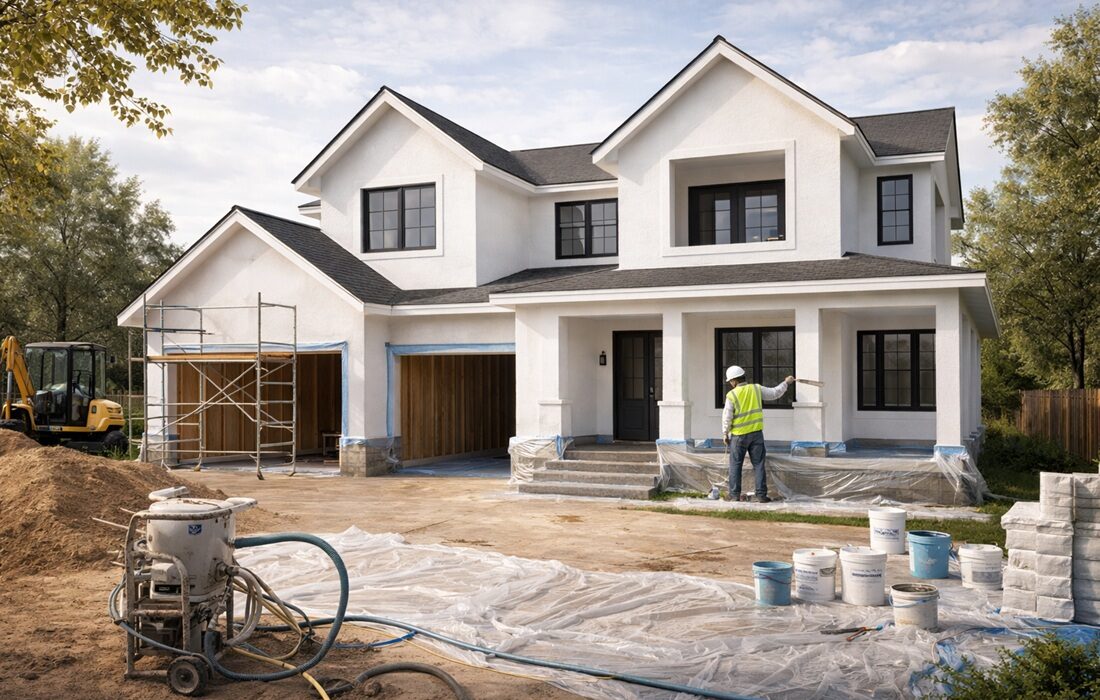
In construction, rendering or render is a protective and decorative coating applied to external walls, sometimes internal walls also. It’s typically a cement-based or acrylic-based material that is sprayed on, then finished to either a smooth, textured, or patterned look.
Clients choose render for two reasons:
-It can change the appearance of a building dramatically
-It can add an extra layer of protection
Rendering is common on new homes, renovations, boundary walls, apartment buildings, and commercial facades.
It’s not just a finish but also interacts with the wall system behind it. A good render job can improve street appeal and weather resistance. A poor render job can crack, stain, or trap moisture creating ongoing maintenance.
What surfaces can be rendered?
Render can be applied to many wall types, but the system needs to match the substrate.
Substrate is the base surface underneath a finish and the material you’re applying the render onto. If a wall is going to be rendered, the substrate might be brickwork, concrete, fibre cement sheet, or another wall panel system. The substrate matters because it affects how well the finish bonds and how it moves.
Clients should ask the following:
-Will it be rendered?
-What wall system is behind it, and what render system is compatible with that?
Different types of render explained
Cement render
This is the traditional mix. It’s typically applied in one or more coats and finished to the desired texture which can be smooth or textured. Cement render can look great, but it’s more prone to cracking if the wall moves or if detailing is poor. It commonly needs painting or a coloured coating system.
Cement render is often used on masonry substrates like brick and concrete.
Acrylic render
Acrylic render includes polymers that improve flexibility and adhesion. It’s generally more crack-resistant than straight cement render and can be used in a wider range of applications, including some lightweight wall systems. Acrylic systems often come with coloured finishes, potentially reducing the need for separate painting.
Acrylic render is popular for modern residential facades and many commercial walls.
Lime render
Lime-based renders are usually found in heritage or restoration work because they can be more breathable and compatible with older masonry. If you’re renovating an older home, lime render may be discussed to suit the original construction and reduce moisture issues.
Where rendering is used
Rendering is most common on:
- external facades to achieve a particular architectural style
- feature walls and entry statements
- boundary walls
- some internal feature walls
- commercial frontages where a consistent, durable finish is needed
- as part of a broader facade package with cladding, brickwork, and architectural mouldings.
Rendering vs plastering: a quick clarification
Rendering is generally for masonry/external wall coatings. Plastering is typically for internal walls and ceilings such as plasterboard. They’re different trades and different systems, even though both involve applying a smooth or textured surface.
What to watch out for with rendering
Most render problems come down to movement, moisture, or poor preparation. Cracking is the most common complaint. It’s sometimes only cosmetic, while other times it’s a sign that the system wasn’t right for the wall.
A few practical things to pay attention when choosing render with your builder:
- whether the render system includes mesh reinforcement where required
- how control joints are handled
- how the builder manages waterproofing interfaces, such as flashings, and sealing around windows
- whether the finish includes painting or a colour coating
- curing time and weather considerations
- what type of maintenance you should expect in the next 1-5 years
What you’ll need to do after handover
Rendered walls aren’t “set and forget.” Most will need periodic washing, and even recoating over time depending on weather exposure. Light-coloured smooth render looks premium, but it can show scuffs, mould, or dirt faster.
If low maintenance is a priority, discuss finish choice, colour, and exposure with your builder before final selection.
IQ Construction can guide you through render selection during the design stage, recommending finishes and colours that suit your style and help you balance look with practical maintenance expectations.