
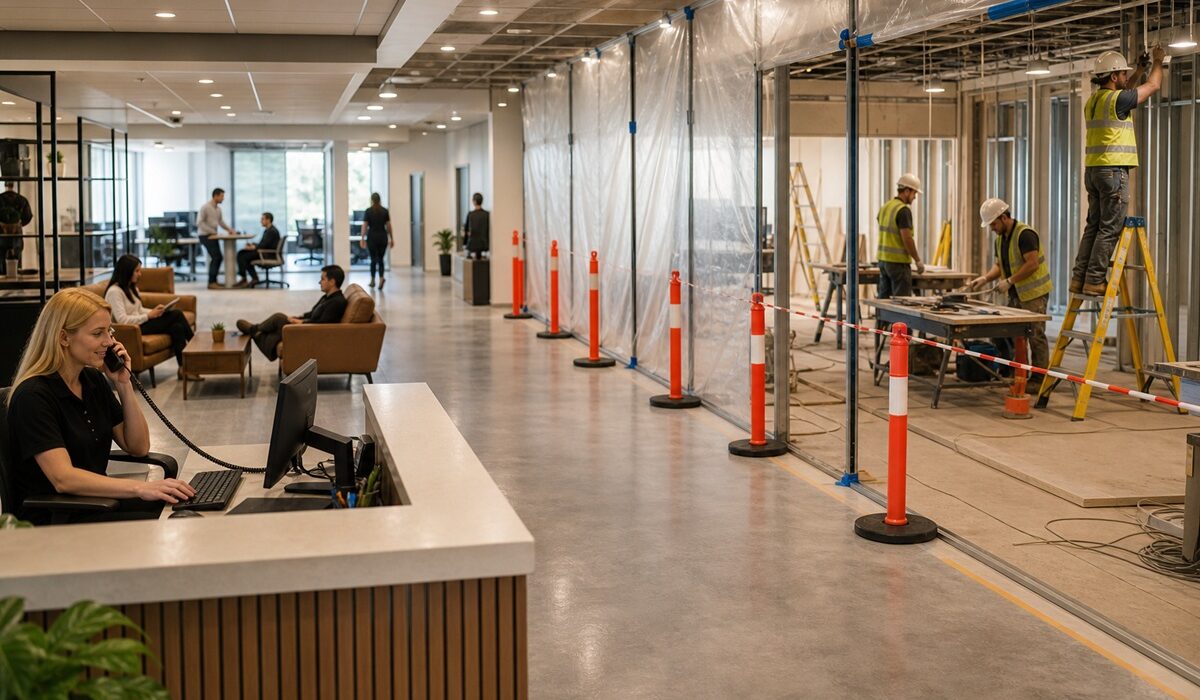
Often, yes, provided the renovation is planned around how the business operates.
Many commercial renovations in Perth are carried out while the business remains partly or fully operational. But that does not mean every project can continue as normal. The success of a live renovation depends on whether customer access, staff movement, safety, building services, and daily operations can still function while construction is underway.
This is most realistic where the work can be broken into stages, isolated to one area at a time, or scheduled around quieter business periods. Renovations to existing commercial premises are common, and in some cases, a business can continue trading without needing a new occupancy permit where the work does not involve a change of authorised use or classification.
In Perth, whether a commercial renovation triggers a new occupancy permit usually depends on the building’s classification, the approved use, and whether the works involve a change of use or classification. If the authorised use and classification are not changing, the issue is often less about getting a new occupancy permit and more about making sure the building works are approved and carried out correctly.
Do I have to close my business during a commercial renovation?
Not always, but sometimes partial or full closure is the better option.
A business is more likely to stay open if the works are mainly cosmetic, if the premises are large enough to work in sections, or if back-of-house and customer-facing areas can be split. A full closure becomes more likely where the project involves structural work, major services disruption, demolition, or heavy impact on customer areas.
There is also a cost and timing trade-off. Keeping a business open during a renovation often means slower staging, tighter access controls, more after-hours work, and more coordination. Closing fully for a shorter period can sometimes be faster and more cost-effective from a construction point of view, even if it is not ideal commercially.
What does staging look like?
Staging is one of the main ways businesses continue operating during renovation.
A staged project might involve:
- renovating the back-of-house first while front-of-house trading continues
- upgrading one office area or one tenancy zone at a time
- moving staff temporarily into another part of the premises
- doing noisy or disruptive work only during certain windows
- separating customer circulation from the construction zone
The advantage of staging is that it reduces business interruption. The downside is that it can make the programme more complex and, in some cases, longer.
How do you minimise business disruption during construction?
The biggest disruptions usually come from poor planning before work starts, not from construction itself. A renovation tends to run more smoothly when the business operation is treated as part of the project plan, not as something that will somehow keep working around it.
The most effective ways to reduce disruption usually include:
- deciding early which parts of the business must stay operational
- isolating construction zones properly
- planning temporary access routes
- coordinating noisy or dusty works carefully
- sequencing service shutdowns in advance
- locking in design decisions early to reduce changes during construction
This is where commercial renovation experience matters. A well-planned project should not only build the space correctly but also protect the business from avoidable downtime.
Don’t overlook services and technology
One of the most common mistakes in live renovations is focusing on walls, ceilings, and finishes while underestimating the impact on the systems the business relies on every day.
Before construction begins, it’s worth planning around:
- internet and data
- phones
- EFTPOS or POS systems
- alarms and security
- air-conditioning
- power shutdowns
- access control systems
Communication is part of the renovation plan
If customers, staff, tenants, or suppliers are affected, communication should be treated as part of the project, not an afterthought.
That may include:
- letting staff know which areas will be affected and when
- warning customers about temporary access changes
- updating signage, websites, or appointment notices
- advising delivery drivers where access points have changed
- explaining any temporary noise, dust, or service interruptions in advance
Can work be done after hours or on weekends?
Sometimes, yes. In Perth, construction noise is generally acceptable between 7am and 7pm Monday to Saturday, excluding public holidays. Work outside those hours, including many Sunday or public holiday situations, usually requires approval, and where approved, a noise management plan is generally required.
The City of Perth states that out-of-hours construction work may only be undertaken once approval has been granted and that, where out-of-hours work is approved, a noise management plan is generally required.
So, after-hours or weekend work can sometimes be part of the solution, especially for customer-facing businesses, but it must be assessed properly and built into the approval and site-management process.
How a business reduce downtime during a commercial remodel?
Downtime is usually reduced when fewer decisions are left unresolved once construction starts.
That means:
- finalising the scope early
- resolving approvals and consultant coordination upfront
- identifying long-lead materials before they affect the programme
- planning around customer traffic or staff occupancy
- understanding when shutdowns must happen
- deciding whether full closure or staged trading is the more practical option
Conclusion
Many businesses can remain operational during a commercial renovation, but only when the works are planned around how the business functions. The more the renovation affects access, safety, customer flow, building services, and core operations, the more carefully it needs to be staged.
If you are planning a commercial renovation in Perth, IQ Construction can help assess whether the business can stay open, how the works can be staged, and what practical steps can reduce disruption, protect operations, and limit downtime while the project is underway.
Contact us for a free consultation on 08 9399 6715