
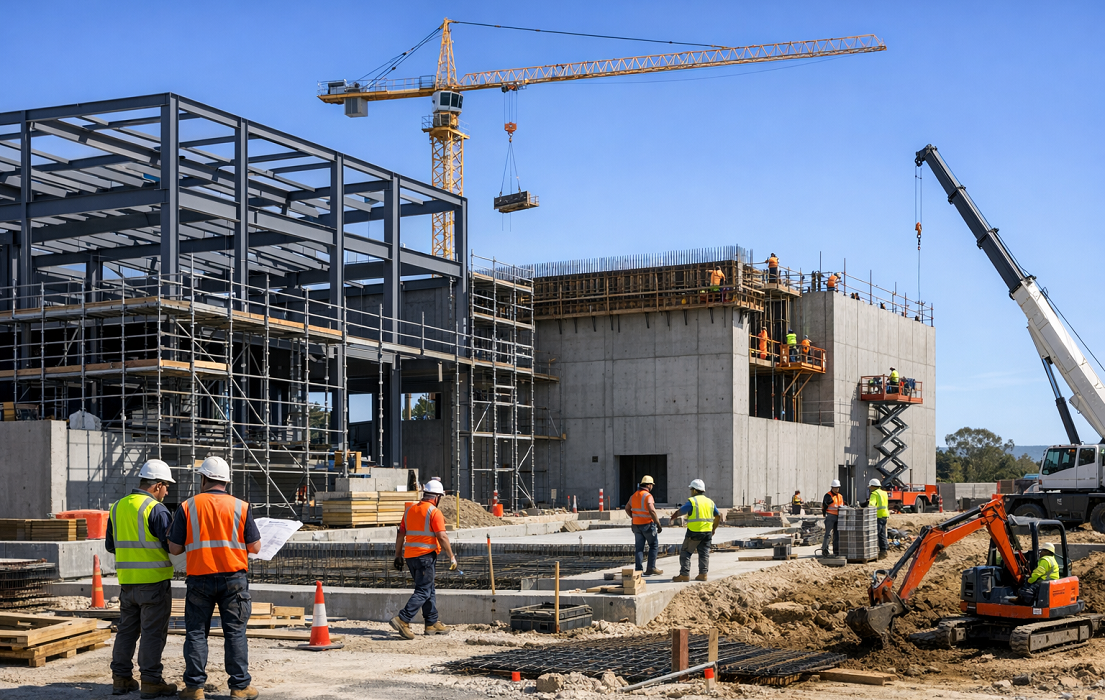
If you’re planning to build a warehouse, office, medical suite, retail building or childcare centre development, the finance process usually looks very different from a traditional construction loan.
A commercial construction loan is a funding facility designed specifically for commercial building projects. Rather than releasing the full loan amount upfront, the lender usually advances funds in stages as construction progresses. Commercial financing tends to involve more scrutiny, reporting, and moving parts as well.
These loans are commonly used by business owners building premises, investors developing commercial assets to lease, landlords upgrading or expanding an existing commercial site, and more.
Understanding how a commercial construction loan works can help you plan more confidently, avoid delays, and structure your project properly.
For broader finance context, ANZ’s property development finance information shows how commercial property funding can consider development timelines, construction work, investment use and project risk.
How is a commercial construction loan different from a normal construction loan?
Commercial construction loans get assessed based on the strength of the project itself, the borrower’s financial position, the proposed use of the building, the construction contract, and the project’s overall feasibility.
As mentioned before, these loans are commonly used for projects such as warehouses, retail buildings, childcare centres, medical buildings etc.
In Perth, this can range from a small owner-occupier workshop in Malaga to a multi-unit industrial development in Canning Vale, a medical centre in Joondalup, or a mixed-use commercial project closer to the CBD.
The main difference is that commercial lenders look beyond the build itself. They want to understand the business case behind the project.
Commercial funding is often more detailed because the project itself can carry greater complexity, greater risk and much larger loan amounts.
With a residential construction loan, the lender is often focused on the borrower’s income, deposit, contract price, and the end value of the home. With a commercial construction loan, the lender may want to assess:
- the purpose of the project
- how the completed property will generate income or value
- the borrower’s business structure and experience
- the level of equity being contributed
- tenancy or lease arrangements
- projected costs versus end value
- contingency planning
- whether the builder and consultant team are suitable for the project
How loan funding works
Like many construction facilities, a commercial construction loan is generally released through staged progress payments rather than one lump sum.
The lender may approve a total facility amount, but the funds are released as the build reaches certain milestones. Depending on the project and contract structure, it may be linked to stages like:
- site works
- slab or foundations
- structural frame
- external envelope
- services rough-in
- internal fit-out
- practical completion
On some commercial projects, the work may instead be based on certified work completed, quantity surveyor assessments, or contract claim schedules. All of this can lead to more red tape and documentation before funding is released.
Why commercial lenders focus so heavily on feasibility
One of the biggest differences with commercial construction financing is feasibility.
- Does the project stack up financially?
- Is the total budget realistic?
- Is there enough equity in the deal?
- What happens if costs rise?
- What is the likely end value?
- Is there enough demand for the completed property?
- If it is an investment project, what income is expected once complete?
Lenders often want a clear picture before approving a commercial project. The outcome is often tied to business use, tenant demand, leasing potential, resale value, and overall market conditions.
While every lender has its own process, they commonly look for information such as:
- full project costings
- building contract and specifications
- council or planning status
- borrower financials
- asset and liability position
- business income or project income projections
- evidence of equity contribution
- feasibility analysis
- rental evidence or lease information, where relevant
- consultant reports
- builder credentials and experience
For larger or more complex builds, a lender may also require independent reports from a valuer, quantity surveyor, or other consultant before construction funding is activated.
This is where cost planning and commercial management becomes important, because lenders often want a clearer picture of project costs before releasing commercial construction funding.
They are essentially assessing the strength of the project as a commercial proposition.
How progress payments work on a commercial project
Progress payments on commercial builds are usually more formal than on a standard home build.
A builder may submit a payment claim as work is completed. The lender may then require supporting documentation before releasing the next drawdown. That documentation could include:
- the builder’s claim
- site progress evidence
- updated cost reports
- certification from a superintendent or contract administrator
- a quantity surveyor’s assessment
- confirmation of approved variations
- invoices or supporting schedules
Even if construction is progressing well, payment delays can still happen if paperwork, certifications, or lender reviews fall behind.
For commercial clients, this is one of the most important practical realities to understand. A project can be build-ready, but finance administration needs to run side by side with the project to ensure there are no delays.
Do you pay interest during the build?
Often, commercial construction loans are structured so that the borrower pays interest on the amount drawn down rather than the full facility from day one. In some cases, interest may even be capitalised during construction, depending on the project and loan structure.
That said, commercial lending repayment can vary depending on:
- the type of borrower
- whether the property is owner-occupied or investment-based
- the lender’s policy
- the level of project risk
- the intended exit strategy after completion
What is the lender’s exit strategy?
In commercial finance, lenders usually want to know what happens when construction is finished. This is often called the exit strategy. The lender wants confidence that the project can move successfully from construction phase to completion phase.
For example:
- Will the completed building be refinanced onto a longer-term commercial loan?
- Will the property be held and leased?
- Will the completed units be sold?
- Will the borrower occupy the premises and trade from it?
- Will the finished project produce enough income to support the next lending phase?
Conclusion
A commercial construction loan is not a larger version of a home construction loan. It involves various stages of drawdowns, lender oversight, detailed documentation, and a focus on feasibility.
For commercial clients in Perth, understanding this early can be critical, directly relating to how smoothly a project moves from concept to contract to construction. The more clearly the project is defined at the beginning, the easier it is to coordinate the lender, consultants, builder, and documentation pathway.
Working with an experienced commercial builder makes all the difference. You need a builder who can provide clear contract documentation, detailed cost planning, realistic construction methodology, well-managed claims, and properly documented variations.
That’s why you should choose IQ Construction! Our team can add value not only through the physical delivery of the project, but also through a clear and professional approach to documentation, coordination, and commercial project execution from the outset.
Are you ready to work with a commercial construction company that has the expertise you need to take your project from start to finish?
Contact us today – (08) 9399 6715.