
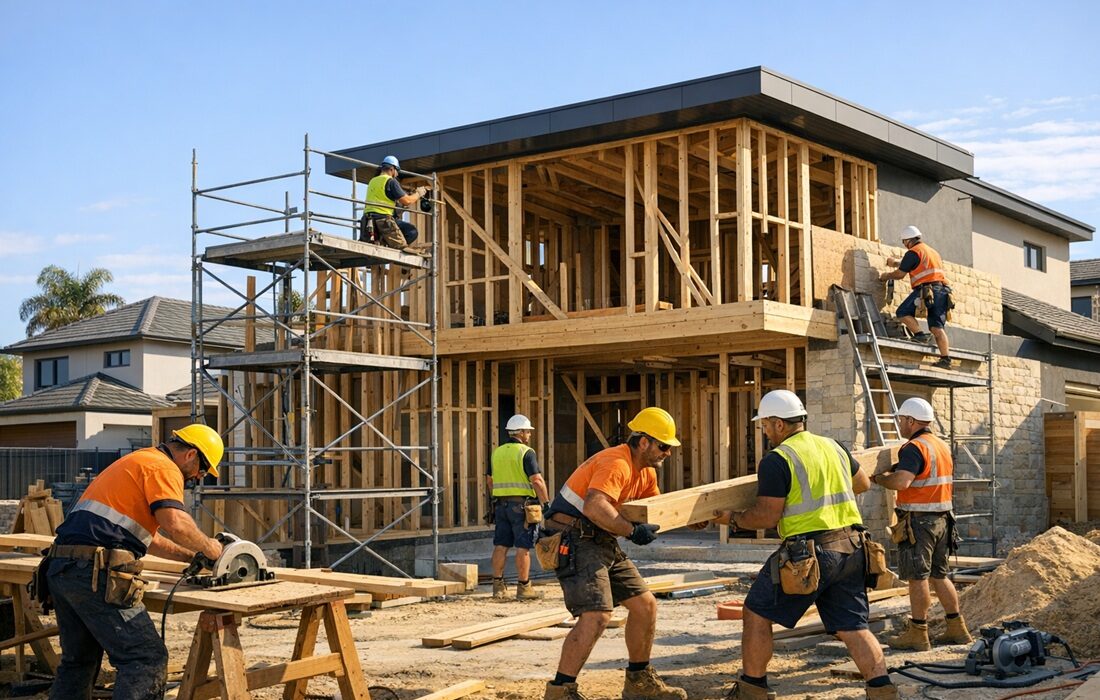
When most people picture a home under construction, they think of the visible parts like walls, windows, roofing, and finishes. But the elements that support the building are often hidden beneath or behind those surfaces, working in the background to keep the structure stable and secure.
If you’ve commissioned a new home, it helps to understand a few of the common structural terms you may come to hear during construction process. Things like footings, lintels, joists, cleats, and gussets all play different roles. Each contributes to how the building carries weight, transfers loads, and stays secure over time.
For readers who want to keep learning about materials, systems and specifications, these Australian building design and specification resources provide extra background without turning this article into a technical engineering guide.
Footings: the load-bearing base of the building
A footing is one of the most important structural elements in any building project. They sit below the building and transfer the weight of the structure into the ground. In simple terms, they help stop the building from sinking, shifting, or settling unevenly.
The type of footing used depends on the soil conditions, the building design, and the loads being carried. In residential construction, footings are commonly part of the slab or foundation system.
Lintels: supporting openings in walls
A lintel is a structural support placed over an opening such as a door, window, or garage opening. Its job is to carry the weight of the wall or structure above that opening and transfer it to the sides.
Without a lintel, the brickwork or framing above an opening would not be properly supported. Lintels may be made from steel, concrete, timber, or other structural materials. It plays a major role in keeping wall openings stable and preventing cracking or failure above doors and windows.
Joists: supporting floors and ceilings
Joists are horizontal structural members used to support floors or ceilings. They span between supports and help distribute loads across the structure.
In a house, joists can sit under flooring systems or support upper levels. In commercial construction, joists can also be part of larger framed floor/roof systems. They may be timber or steel depending on the design. Poorly designed or undersized joists can lead to excessive movement, bouncing, or structural issues.
Cleats: small connectors with an important job
A cleat is a connection component used to fix one structural element to another. It is often a small steel angle, plate, or bracket, but it has an important role in helping structural members stay connected and transfer loads correctly.
Cleats are commonly used in steel and timber framing, where beams and joists need a secure fixing point. They are not usually visible once construction is complete, but still critical.
Gussets: strengthening structural connections
A gusset is a reinforcing plate used at a connection point between structural members. It helps strengthen the joint and distribute loads across the connection.
Gussets are often used in steel structures, roof trusses, and framed systems where multiple members meet. In timber roof trusses, gusset plates are a common way of tying the truss elements together.
Like cleats, gussets are not the part most people notice, but they are essential in making sure structural joints remain stable under load.
Conclusion
Each of these structural elements serves a different purpose, but together they help a building carry weight safely and remain stable over time. Some support the structure from the ground up, others span openings or floor areas, and some strengthen the connections that hold everything together. You do not need to know every technical detail, but understanding these terms can make it easier to follow plans, ask questions, and understand how a building is put together.
If you’re planning a residential or commercial project in Perth, IQ Construction can guide you through the structural side of the building from early design through to construction, helping you understand how the key building elements work together.